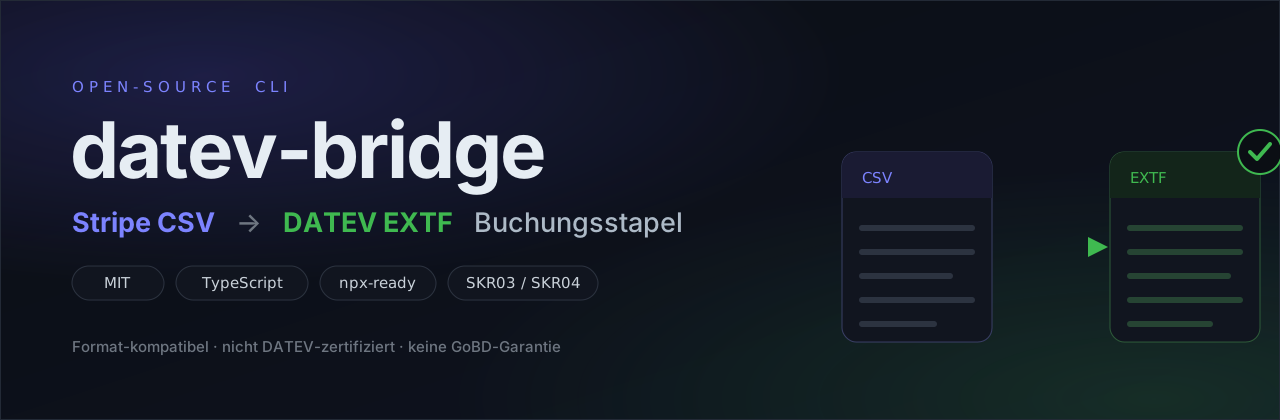


Convert CSV exports from payment tools into a DATEV EXTF Buchungsstapel
adapter-based, with a declarative, versioned mapping. Stripe today; PayPal, Shopify, bank CSV next.
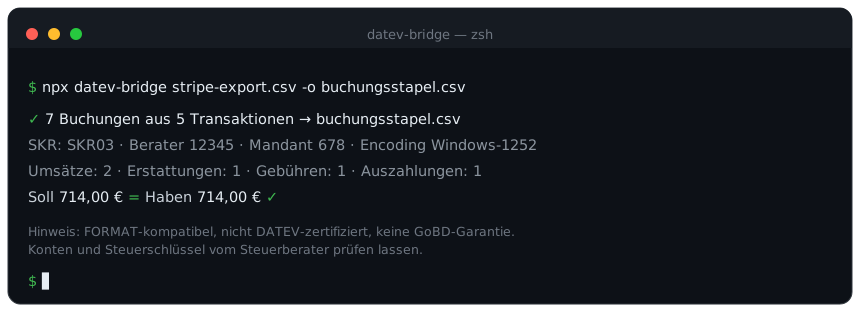
npx datev-bridge stripe-export.csv -o buchungsstapel.csv
Important
datev-bridge is format-compatible with the DATEV EXTF import — it is not a DATEV product, not DATEV-certified, and makes no GoBD guarantee. The account and tax-key defaults reflect common German practice for Stripe but must be confirmed by your tax advisor (Steuerberater) for your specific situation (Kleinunternehmer, reverse-charge handling, chart-of-accounts setup). You stay responsible for what you import.
Stripe (and friends) export CSVs; DATEV imports the EXTF "Buchungsstapel". Bridging the two correctly is fiddly: a Stripe payout is not revenue (Stripe behaves like a bank account / Geldtransit), the processing fees are an EU reverse-charge service (§13b UStG) because Stripe bills from Ireland, and DATEV only imports if the file is byte-correct (ISO-8859-1/Windows-1252, semicolons, CRLF, comma decimals, the right column order).
The existing open-source tools either pull from the API (needs keys) or are pure format writers with no source mapping, and the only one with real mapping is single-source Python. datev-bridge fills the open niche: an OSS, CSV-based (no API key), Node/npx CLI with a source-adapter architecture and code-as-config mapping you can version in git.
![Pipeline: Stripe CSV → adapter → Transaction[] → mapping + YAML → Booking[] → EXTF writer → buchungsstapel.csv](https://raw.githubusercontent.com/juli1111/datev-bridge/main/assets/pipeline.svg)
- Source adapters normalize a provider's CSV into a provider-agnostic transaction model. New source = one new adapter.
- Declarative mapping (YAML, validated with Zod) holds your accounts and tax keys — nothing is hardcoded.
- EXTF writer produces a spec-correct Buchungsstapel: 31-field Vorlauf header, 125 data columns, Windows-1252 encoding, CRLF, comma decimals,
TTMMBelegdatum, positive Umsatz with explicit Soll/Haben.
# one-off
npx datev-bridge --help

# or install globally
npm i -g datev-bridge
Requirements: Node.js >= 18.
datev-bridge <input.csv> [options]

Options:
  -o, --output <file>     output EXTF file            (default: buchungsstapel.csv)
  -a, --adapter <id>      source adapter              (default: stripe)
  -c, --config <file>     YAML mapping config (merged onto the SKR preset)
      --skr <skr>         SKR03 | SKR04
      --berater <nr>      DATEV Berater-Nr (>= 1001)
      --mandant <nr>      DATEV Mandanten-Nr
      --bezeichnung <txt> batch label shown in DATEV
--stdout write bytes to stdout instead of a fileIn the Stripe Dashboard → Reports → Balance → "Balance change from activity", export the Itemized report for your period. That report lists every money movement (charges, fees, refunds, payouts), which is what you need for full bookkeeping. (See Stripe docs.)
datev-bridge stripe-itemized-2026-01.csv \
  -o buchungsstapel-2026-01.csv \
  -c my-mapping.yaml \
--berater 12345 --mandant 678Stripe is treated as a Geldtransit / clearing account — a payout is a transfer to your bank, not revenue. Defaults for SKR03 (SKR04 in parentheses):
| Transaction | Soll (debit) | Haben (credit) | Tax key | Note |
|---|---|---|---|---|
| Sale (charge) | Geldtransit 1360 (1460) | Erlöse 19% 8400 (4400) | — automatic | gross/brutto; DATEV derives the VAT |
| Stripe fee | Gebühren 4970 (6855) | Geldtransit 1360 (1460) | 506 | §13b reverse charge EU 19% |
| Refund | Erlöse 19% 8400 (4400) | Geldtransit 1360 (1460) | — automatic | reverses the sale |
| Payout to bank | Bank 1200 (1800) | Geldtransit 1360 (1460) | — | money leaves Stripe |
Two defaults are the usual sources of error, and both are handled here:
- Geldtransit principle — booking the payout, not the individual sales, as revenue is wrong. Sales hit revenue; the payout only moves the net to the bank.
- §13b on fees — Stripe Payments Europe bills from Ireland, so the fee is a reverse-charge service. The default key is 506 (§13b EU 19%), not the generic BU 94, which would force a manual EU selection on every booking.
All of this is configurable in the YAML mapping, and all of it should be confirmed by your tax advisor.
Start from a preset and override only what differs. See configs/stripe-skr03.example.yaml and configs/stripe-skr04.example.yaml.
meta:
  skr: SKR03
  beraterNr: 12345        # required for a real import
  mandantNr: 678
  sachkontenlaenge: 4     # must match the DATEV mandant setup
  festschreibung: 0       # 0 = advisor reviews before locking
accounts:
  geldtransit: 1360
  bank: 1200
  revenue19: 8400
  revenue7: 8300
  fees: 4970
taxKeys:
  revenue19: ""           # automatic account → empty
  fees: "506"             # §13b reverse charge EU 19%
options:
  defaultVatRate: "19"
Without -c, the built-in SKR03 defaults are used (with placeholder Berater/Mandant numbers and a warning).
Supported now: charge (revenue + fee), refund, standalone Stripe fee, payout.
Not yet (skipped with a warning, never silently mis-booked): disputes/chargebacks, balance adjustments, foreign-currency exchange differences, per-line VAT detection (the MVP applies one default VAT rate), sub-ledger debtors, and pRAP period accrual. These are on the roadmap.
Each export must cover a single fiscal year — EXTF stores the Belegdatum as TTMM without a year, so datev-bridge refuses a mixed-year file rather than guess.
Note
Kleinunternehmer (§19 UStG): the defaults assume a VAT-liable business with full input-tax deduction, so the §13b reverse charge on Stripe fees nets to zero. If you use the §19 small-business scheme, §13b still applies but the self-assessed VAT becomes a real cost (no input-tax deduction), and revenue is booked without VAT — adjust the mapping accordingly and confirm with your tax advisor.
import { convert } from 'datev-bridge';
import { readFileSync } from 'node:fs';

const { buffer, bookingCount, warnings } = convert({
  csv: readFileSync('stripe-export.csv', 'utf8'),
  overrides: { skr: 'SKR04', beraterNr: 12345, mandantNr: 678 },
});
writeFileSync('buchungsstapel.csv', buffer); // CP-1252 bytes- PayPal, Shopify Payments and generic bank-CSV adapters
- Foreign-currency exchange-difference handling
- Per-line VAT detection (tax columns / metadata)
- Dispute / chargeback bookings
- Optional pRAP period accrual for subscriptions
- Sub-ledger debtor bookings
New source adapters are very welcome — that is the whole point of the architecture. See CONTRIBUTING.md and the adapter guide.
npm install
npm run check      # typecheck + lint + test
npm run build # bundle to dist/ via tsupFormat and mapping cross-checked against the open, MIT-licensed
ledermann/datev (EXTF reference) and
jonaswitt/stripe-datev-exporter
(Stripe booking logic). The DATEV field semantics are re-implemented from the
public format description, not copied.
MIT © Julian Abt. "DATEV" is a trademark of DATEV eG; this project is independent and not affiliated with or endorsed by DATEV.